Google launched two significant updates to Search Console on June 3rd: dedicated reports for generative AI visibility and a toggle to block your content from appearing in AI features altogether. The rollout is currently limited to a small group of UK site owners, pushed forward by regulatory pressure from the UK's Competition and Markets Authority (CMA) rather than Google's own goodwill.
Here's is what the SEO community is saying about it.
Generative AI Perfromance in Google Search Console
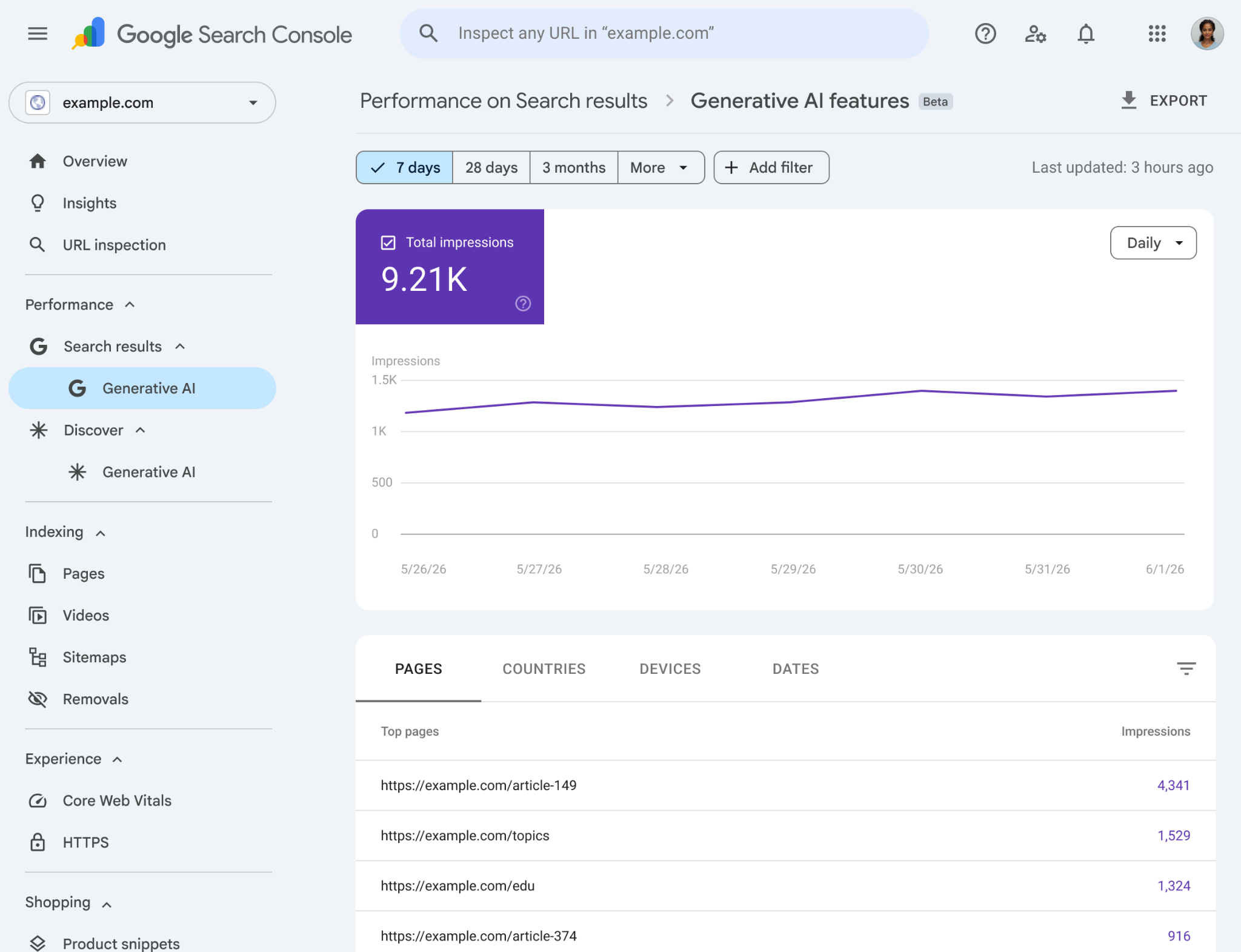
The new Search Generative AI performance report lives inside Search Console and tracks how often your pages appear inside AI features - AI Overviews, AI Mode, and AI features in Discover. You get five dimensions:
- Impressions: how often your URLs showed up in AI-generated responses
- Pages: which specific URLs appeared
- Countries: geographic breakdown
- Devices: desktop vs. mobile (Search only)
- Dates: daily, weekly, monthly granularity (data starts May 18, 2026)
The most interesting measure is missing: clicks. Google's response when Barry Schwartz of Search Engine Roundtable asked? "We're continuing to work with website owners to understand what insights will be most helpful to inform their strategies, and we'll introduce additional metrics over time." In other words: we know you want it, we're not giving it to you yet.
Keep your content out of AI Overview
Alongside the report, Google is also rolling out a control that lets site owners opt their content out of AI features entirely. Using it means your content won't appear in AI Overviews, AI Mode, or AI-powered Discover results — and Google has confirmed this won't affect your rankings in standard search.
That last part matters. The fear was always that opting out would be punished elsewhere. Google says it won't be.
For the current test group, the toggle becomes active on June 17, 2026. For everyone else there is no ETA when it will be launched.
Why was the UK launched first?
This wasn't Google's initiative. The CMA struck a deal that requires Google to give publishers opt-out rights, including from having their content used to fine-tune AI models. Google now has nine months to roll this out fully across the UK. Global availability? Still unclear.
What is the SEOs community saying about it
The reaction in the SEO community is a mix of appreciation and frustration.
Barry Schwartz, who's been tracking this since early leaks suggested the report would be called the "AI contribution report," called it "a good and welcome step forward" — but didn't skip over the obvious: no click data is a major gap. Impressions without clicks tell you your content is appearing inside AI answers, but not whether anyone is acting on it. That makes measuring the actual business value of AI visibility nearly impossible right now.
Lily Ray has been calling the AI measurement problem "Not Provided 2.0" — a pointed reference to how Google killed keyword-level click data in 2013, leaving SEOs to work with aggregated data that obscured more than it revealed. The parallel feels apt: Google is showing you that you're being used, just not whether that usage translates to anything.
The blocking question is also genuinely divisive. In a poll Schwartz ran earlier this year, 33% of SEOs said they'd block Google from showing their content in AI features. Whether that holds now that the toggle is real remains to be seen — once people see their impressions data and realize AI features are driving zero clicks, that number might move.
Barry Adams, who has written plainly about what AI Mode means for publishers, frames the stakes clearly: for content businesses that depend on search traffic, the shift to AI-generated answers isn't just an inconvenience. It's a structural threat. Having a report that shows impressions is useful. Having one that also shows zero referral traffic attached to those impressions would be damning in a more clarifying way.
What to Do Right Now
If you're in the UK and have access: check the report, note your baseline impressions, and think carefully before using the blocking toggle. Once you opt out and it takes effect June 17th, you're out.
If you're outside the UK: nothing to do yet. Watch for the global rollout and set up your measurement frameworks now so you're ready when access comes.
The real question this report raises isn't whether your content appears in AI features. It's what showing up there actually means for your business — and right now, Google still isn't giving you enough data to answer that.